Docs
Position Records
Review & Playbooks
Position Lifecycle
The lifecycle is not one state machine
A position’s actual stage comes from the combination of Status, Opened At, Closed At, Exit Price, and other fields. One enum does not control the complete lifecycle.
This matters because LucrJournal lets these fields be empty independently and lets them be temporarily inconsistent. To decide whether a position is closed, the system checks only two conditions: Status is Close, or Closed At has a value. Either condition makes the position closed.
For example, when you enter an Exit Price, the plugin changes Status to Close but does not fill in Closed At. The position already counts as closed, but its duration still has no end time.
Creation stage
The creation stage is when Save Position first writes the position file. The normal creation flow writes:
StatusasOpen.Opened Atas the current time in your configured timezone.- The
Sideselected during creation. - Empty
Confidence,Notional Value,Risk, andFeevalues. - An initial
Net PnLof 0. - An empty
Notessection.
These empty values matter. They mean the information is incomplete. They do not mean the plugin has calculated a result of 0.
For example, you can choose only an account, a symbol, and LONG, then save the position. It already has a stable identity and open time. You can add prices, quantity, and the plan later.
The creation stage is directly related to accounts and symbols. The plugin first confirms that the account exists, then ensures that the symbol exists under that account, and finally links the position to the symbol. See Platforms, Accounts, Symbols, and Positions for the complete relationship.
Open stage
The position is in the open stage while it does not meet the rule “Status is Close or Closed At has a value.” Execution facts, position size, and the trade plan matter most during this stage.
| Field | Meaning during this stage | Related result |
|---|---|---|
Symbol |
Determines account ownership, type, fee, and contract unit. | Quantity semantics, notional value, fee. |
Side |
Determines the positive or negative direction of a price move. | Risk, Planned R:R, Real R:R, net profit. |
Entry Price |
The only entry price used by formulas. | Notional value, risk, and result. |
Amount, Contract, or Lots |
Represents position size according to the symbol type. | Notional value. |
Stop Loss |
Represents the planned adverse price distance. | Risk, Planned R:R, Real R:R. |
Target Price |
Represents the planned favorable price distance. | Planned R:R. |
Confidence |
Stores your subjective score for the trade. | Review filtering; it does not change formulas. |
For example, after you add an entry price, quantity, and stop loss to a LONG position, the plugin can derive notional value and risk. It can derive Planned R:R only after you also add a target price. If a required input is missing, the related result has no reliable meaning.
These fields are directly related to the symbol type. Amount, Contract, and Lots are not interchangeable. See Symbol Types.
Closed stage
The position is in the closed stage once LucrJournal decides that it has ended. The condition is Status set to Close, or any value in Closed At.
Closing matters because backlink statistics use it as the first condition for a performance sample. Open positions do not enter calculations for win rate, net profit, largest profit, or largest loss.
When you write an Exit Price that can be converted to a finite number, the plugin automatically sets Status to Close but does not add Closed At. In the other direction, entering only Closed At is enough to make the position closed even if Status is still Open.
Different results need different inputs after closing:
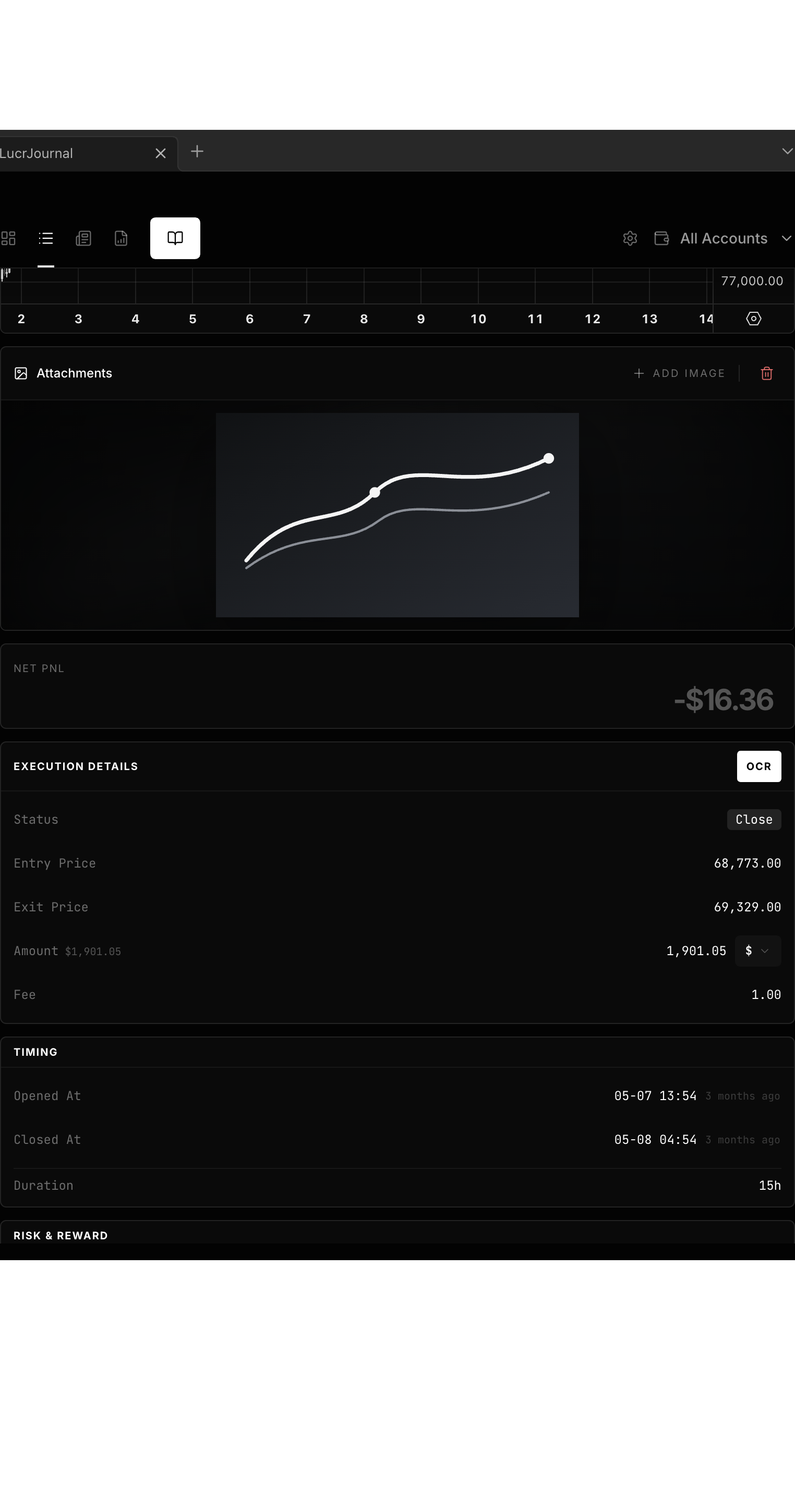
Net PnLneeds Side, Entry Price, Exit Price, and Notional Value, then subtracts Fee. The formula uses one entry price and does not calculate an average entry price.Real R:Rneeds Side, Entry Price, Exit Price, and Stop Loss. It recalculates from source fields. It does not read the saved net profit or risk, and it does not include fees.Durationneeds Opened At and Closed At. Status or Exit Price alone cannot produce a complete duration.
For example, a LONG position has an entry price of 100, a notional value of 1,000, an exit price of 110, and a fee of 2. Its net profit is 98. With a stop loss of 95, Real R:R is 2. The fee that reduces net profit to 98 does not change this R:R.
The closed stage is related to context and playbook statistics. Closing is not enough by itself. Net profit must also be a nonzero number before the position enters these backlink performance metrics. See Context Notes -> How backlink statistics are calculated for the exact rules.
Reopening a position
Reopening means explicitly changing Status back to Open. If the same update does not also provide Closed At, the plugin clears the previous close time.
This matters because clearing Exit Price by itself does not reopen a position. In the other direction, changing only the status does not automatically clear an old exit price.
For example, after entering an exit price by mistake, you can clear the exit price, but the status may remain closed. Explicitly changing the status back to Open clears Closed At when the same update does not include a close time. Whether the old exit price remains depends on whether you cleared it separately.
Reopening is related to Status, Closed At, and Exit Price. It does not change the fixed Side selected during creation, and it does not create a new position record.
Completing the review
A completed review is a level of content completeness. It is not a third LucrJournal position status. The plugin has only Open and Close values. It has no “reviewed” status.
This boundary matters because completing Confidence, Notes, News, Key Levels, Market Analysis, Confluence, or a playbook does not trigger a new lifecycle transition. You decide whether the record answers your review questions well enough to be complete.
For example, after a closed position includes its execution facts, screenshots, original notes, related context, and playbook, you can consider the review complete. The system still treats it only as a closed position.
The review stage is related to Context Notes, Charts, Attachments, and OCR, and Playbooks and Criteria. These records add the “why” and “what I learned.” They do not change whether the position is open or closed.
Update boundaries for derived values
Notional Value, Fee, Net PnL, and Risk are derived values recalculated from source fields. When you change related prices, quantity, or the symbol, the plugin tries to update them from the current inputs. If you edit a derived value directly, the manual result remains until a later source-field change overwrites it.
Deletion is not a lifecycle state
Deleting a position moves the current position file to the trash. It is not a close or review transition. The account, symbol, playbook, and context files are not removed with this direct deletion.
Continue reading
- Record Your First Position: Create a complete position.
- Position Details: Complete execution, time, risk, and context.
- Review Workflow: Turn closed records into reusable conclusions.